
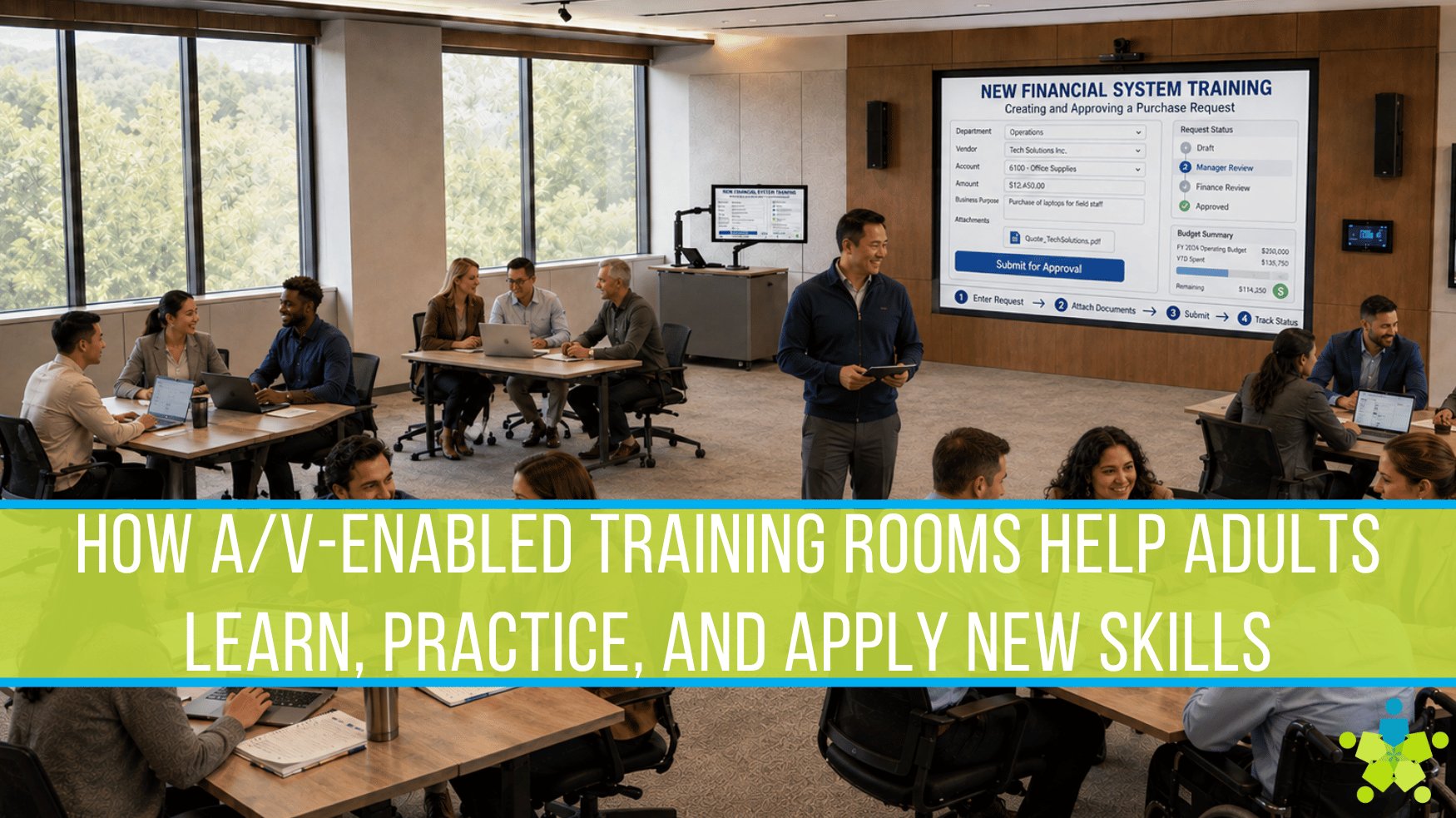
How A/V-Enabled Training Rooms Help Adults Learn, Practice, and Apply New Skills
Training Rooms Are No Longer Presentation Spaces. They Are Performance Spaces.
A training room should do more than display slides.
For corporate and government teams, training often carries real operational weight. Employees need to understand new systems. Supervisors need consistent onboarding. Public-sector teams need reliable compliance training, emergency preparedness, and procedural updates. In many cases, the goal is not simple awareness. The goal is behavior change.
That is where audiovisual design matters.
A well-designed A/V training room supports the way adults learn best: through relevant content, clear communication, active participation, guided practice, and immediate application. Adult learning guidance rooted in Knowles’ andragogy emphasizes that adults are motivated when training connects to their jobs, respects their experience, and helps them solve real problems.
The room should reinforce those principles, not work against them.
Adult Learners Need Relevance, Not Just Information
Adults bring experience into the room. They also bring pressure: deadlines, job responsibilities, public accountability, and limited time.
That means training has to answer one question quickly: “How does this help me do my job?”
A/V can help make that connection visible.
Large displays, DV-LED walls, interactive displays, and content-sharing systems allow trainers to move beyond static lecture. They can show real workflows, compare examples, annotate documents, review dashboards, and walk teams through scenario-based decisions.
This supports a core adult learning principle: training works better when learners see immediate relevance to their work.
The technology is not the lesson. It is the environment that makes the lesson easier to understand, discuss, and apply.
Clear Audio and Visuals Reduce Cognitive Load
Poor audio can make training feel harder than it needs to be. So can dim displays, small text, bad camera angles, confusing inputs, and inconsistent room controls.
When people strain to hear, see, or follow the presenter, they spend energy on the room instead of the content.
- Microphones that capture the trainer and participants clearly
- Cameras that frame speakers and room activity for remote learners
- Displays sized for legibility from every seat
- Assistive listening support where required
- Lighting and acoustics that support attention
- One-touch controls that reduce delays and confusion
Multimedia learning research shows that people learn more effectively when words and visuals work together in a clear, intentional way.
In practical terms, the room should help trainers present information in layers: explain, show, demonstrate, discuss, and practice.
Interactive Tools Turn Training Into Practice
Adults learn by doing.
A training room with interactive displays, wireless sharing, annotation tools, confidence monitors, cameras, and flexible routing can shift the session from “watch this” to “try this.”
Instead of asking learners to remember a process later, trainers can guide them through the process in the room. Teams can break into groups, share work to the main display, compare decisions, markup a policy, or practice a response scenario.
The point is not to add technology for its own sake. The point is to create a room where participation is easier.
Hybrid Training Requires More Than a Webcam
Many organizations now train mixed audiences: some in the room, some remote, and some watching later.
A basic webcam is not enough for a training environment.
- AI-enabled cameras for presenter and participant framing
- Ceiling or table microphones for clear discussion capture
- Integrated speakers for natural room audio
- Content routing across all displays
- Recording or streaming tools for later review
- Platform interoperability (Teams, Zoom, Google Meet, etc.)
- Simple room controls for trainers
This supports access and consistency. Everyone should receive the same core message regardless of location.
The Best Training Rooms Protect Trainer Momentum
Even strong trainers can lose momentum when the room is hard to operate.
Good A/V design reduces those interruptions through reliability, clarity, and simple control.
- One-touch room startup
- Preset training modes
- Standardized controls across rooms
- Centralized monitoring
- Clear documentation
- Long-term support models
The easier the room is to run, the more time trainers can spend teaching.
Where Corporate and Government Training Rooms Differ
Corporate Training Rooms
- Onboarding
- Sales training
- Leadership development
- Product launches
- Customer education
- Safety and compliance
- Hybrid workshops
- Executive briefings
Government Training Rooms
- Emergency operations training
- Department onboarding
- Public safety coordination
- Compliance training
- Interagency meetings
- Community education
- Policy updates
A/V Should Serve the Learning Strategy
The most effective training rooms begin with learning goals, not equipment lists.
- What should learners be able to do after training?
- Will the room support lecture, discussion, practice, or simulation?
- How many in-person and remote learners are expected?
- What platforms must be supported?
- What accessibility requirements apply?
- Who will operate the room?
- What support model is required?
Common Questions
Do training rooms need premium A/V?
No. The system should match the use case and training goals.
How does A/V support accessibility?
Through assistive listening, clear visuals, captioning workflows, and proper microphone coverage. Accessibility should not make the participant sit close to the presenter.
Can one room support hybrid training?
Yes, if designed for it from the start.
What is the biggest mistake organizations make?
Designing around equipment instead of learning outcomes.
Conclusion: Better Rooms Create Better Training Conditions
Adult learners need training that is relevant, clear, participatory, and practical.
A/V-enabled training rooms help create those conditions by improving clarity, participation, hybrid access, and trainer efficiency.
For corporate and government leaders, the opportunity is not just to modernize a room. It is to build a training environment that improves performance.


Darlene Rankin
Darlene Rankin is the Education Business Development Manager at Data Projections, Inc. She is an accomplished education technology leader with over twenty years of experience, including twenty-four years as Director of Innovation and Instructional Technology at Katy ISD in the Greater Houston Area. In 2025, she joined DPI to focus on expanding AV technology solutions for Texas schools and supporting innovation, collaboration, and student success.