
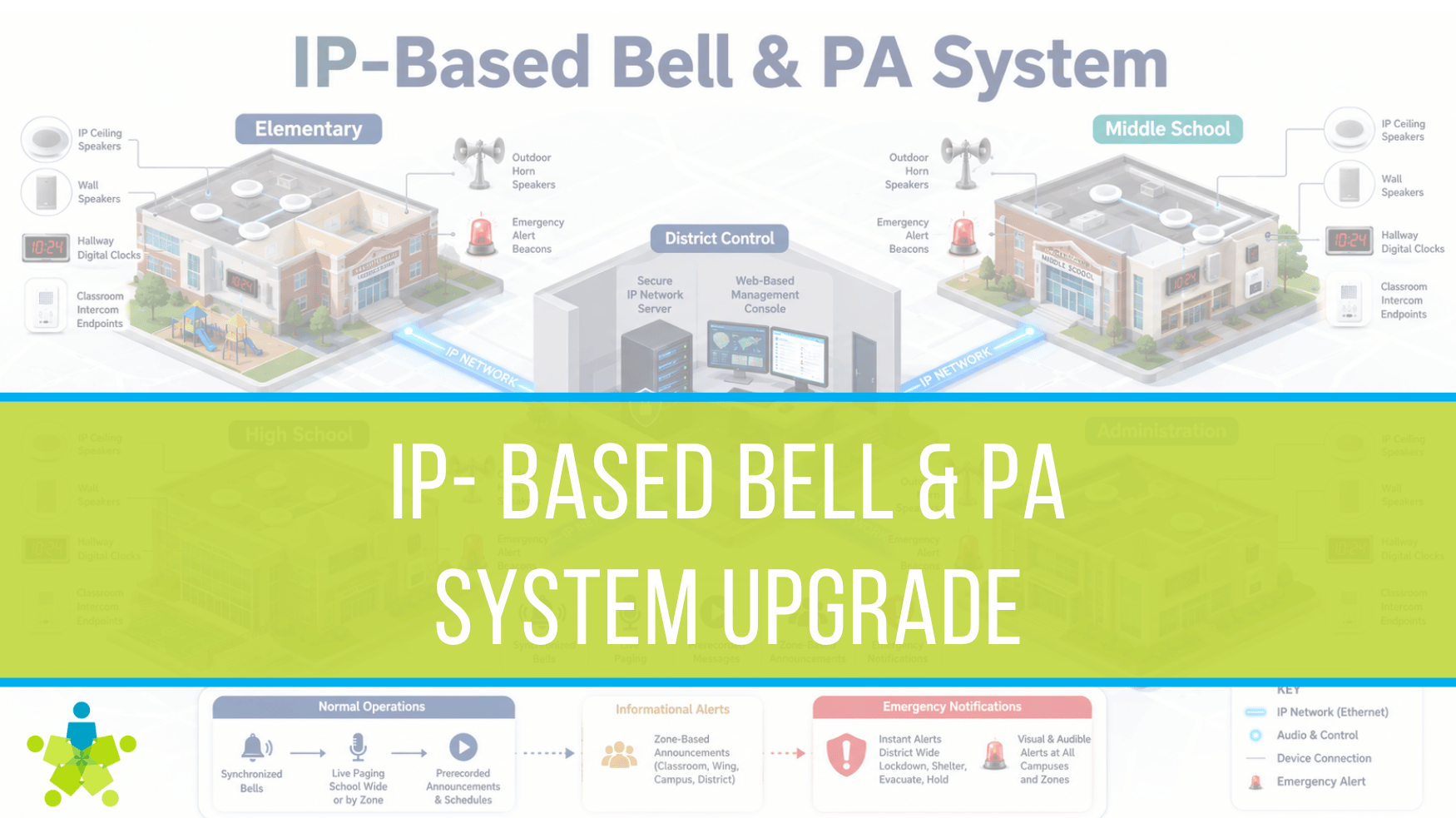
The Advantages of Upgrading from an Analog Bell and PA System to an IP-Based Bell and PA System
Bell and PA systems do not always get attention until they fail.
For many K-12 districts, the legacy analog system still runs the daily schedule. It rings bells between classes. It carries morning announcements. It may support basic one-way paging from the front office.
But schools now ask more from communication systems than they did when many analog systems were installed. IP-based systems are smart systems and can deliver much more. Below you will read a few reasons why these smart systems are worth the investment. You can use and test these systems in day to day operations as well as in urgent situations. Therefore, campuses are always testing their system to ensure each and every speaker, display, cell phone, computer, 2-way radio receives notifications.
Campuses need flexible schedules. Front offices need faster ways to reach the right zones. Teachers need clear audio without confusion. Administrators need systems that support everyday communication and urgent alerts. District technology teams need tools they can manage across buildings without chasing isolated hardware issues room by room.
That is where an IP-based bell and PA system can make a measurable difference.
An IP-based system uses the data network to manage bells, paging, audio, scheduling, and alerts. Instead of relying only on fixed analog wiring and centralized legacy equipment, the system connects devices through the network. This gives schools more flexibility, better control, and a stronger foundation for future communication needs. Some people may think they do not want an IP-based system due to network failure. Only the local area network needs to be functioning for the PA and bell system to function.
For districts planning modernization, upgrading from an analog Bell and PA system to an IP-based Bell and PA system is not just a technical refresh. It is a practical step toward clearer communication, faster response, and easier daily operation.
1. Flexible Scheduling Across the Campus
Analog bell systems are often built around fixed zones and fixed schedules. Making changes can require manual programming, vendor support, or work at a central control panel. That can create friction for schools that manage assemblies, testing days, delayed starts, early release schedules, or campus-specific events.
An IP-based bell system makes scheduling more flexible.
Administrators can create, adjust, and manage bell schedules from a software interface. Different campuses, buildings, grade levels, or zones can follow different schedules when needed. A high school can run a modified testing schedule while an elementary campus follows its normal day. A gym, cafeteria, or outdoor area can receive separate bell patterns or announcements.
This flexibility matters because school days are not as uniform as they used to be. Campuses need communication tools that support real operations, not just ideal schedules.
2. Clearer, More Targeted Paging
In many analog PA systems, paging is broad by default. An announcement may go to the entire building when it only applies to one hallway, one wing, or one outdoor area. That can interrupt instruction and create announcement fatigue. This is extremely important on testing days allowing the administrator to ring bells and deliver annoucments to specific classrooms and/or zones.
IP-based PA systems make targeted communication easier.
Office staff can page specific rooms, zones, campuses, or groups. A message for the cafeteria does not need to interrupt every classroom. A transportation update can go to the front entrance and bus lanes. A campus-wide message can still be sent when needed, but routine communication becomes more precise. Urgent messages about weather or other urgent matters are predefined and are sent to the appropriate people and device(s). When a weather alert is triggered, the smart system already knows who must receive the message and if they should see it on computer, cell phone, 2-way radio, digital signage, etc.
For teachers, that means fewer unnecessary interruptions. For administrators, it means messages reach the right audience faster. For students, it means a school day with less noise and more clarity.
3. Better Support for Emergency Communication
Schools need communication systems that can support both everyday use and urgent situations.
Analog systems may provide basic paging, but they can be limited when a campus needs faster, more coordinated alerting. An IP-based Bell and PA system can support more advanced emergency communication workflows, especially when paired with visual alerts, digital signage, silent alarm integrations, or other safety tools.
For example, an IP-based system can help administrators send urgent messages to specific zones or the full campus. It can support pre-recorded announcements so staff do not have to improvise under pressure. It can also integrate with visual notification systems, helping reach areas where audio alone may not be enough. Two-way radios are frequently used on campuses and the smart system will send audio messages to this technology as well.
DPI’s K-12 messaging emphasizes district-wide communication, safety alerts, simple teacher experiences, and reliable coverage across campuses. These priorities align closely with what many districts need from a modern IP-based Bell and PA system. The system is always tested because it is being used in day to day operations.
The goal is not to claim that one system solves every safety challenge. It does not. Safety depends on policy, training, procedures, and coordinated tools. But a modern communication platform can give staff a clearer, faster way to share instructions when time matters.
4. Easier District-Wide Management
Analog systems can be difficult to manage at scale. Each campus may have its own equipment, wiring constraints, control points, and service history. When something breaks, the technology or maintenance team may need to troubleshoot locally. That takes time and can create inconsistent performance across the district.
IP-based systems are easier to centralize.
A district technology team can often manage schedules, zones, devices, and system settings through a network-connected platform. Depending on the system design, staff may be able to monitor device status, identify issues more quickly, and make updates without physically visiting every building.
This is especially useful for multi-campus districts. It supports consistency while still allowing each school to operate according to its own needs.
For IT teams with limited bandwidth, centralized management can reduce the daily burden of maintaining communication infrastructure. It also creates a better foundation for documentation, training, and long-term support.
5. Stronger Integration with Digital Signage and Visual Alerts
Audio is important, but it is not always enough.
Some areas are noisy. Some students or staff may have hearing differences. Some messages need to be seen as well as heard. In other cases, a visual alert can reinforce an audio message and reduce confusion.
IP-based Bell and PA systems can integrate more easily with visual communication tools, including digital signage, classroom displays, hallway screens, computers, cell phones, and visual alert systems. In a K-12 environment, that can support daily announcements, schedule changes, emergency messages, wayfinding, and campus-wide notifications.
A bell is useful. A PA system is useful. But a connected communication environment can do more.
6. Improved Audio Coverage and Intelligibility
An announcement only works if people can understand it.
Many older analog systems suffer from uneven audio coverage, aging speakers, unclear paging, or dead zones. Some classrooms may hear announcements clearly. Others may hear muffled audio, inconsistent volume, or nothing at all.
An IP-based upgrade gives districts an opportunity to reassess coverage and intelligibility. During a modernization project, an AV partner can evaluate speaker placement, room acoustics, paging zones, outdoor areas, and high-noise spaces. The result should be a system designed around how people actually hear messages throughout the campus.
This is not just a convenience issue. Clear communication supports daily operations, safety procedures, and staff confidence. If a message matters, it needs to be heard and understood.
7. Better Scalability for Future Needs
Depending on the age of the analog system, it can be hard to expand. Adding new rooms, buildings, or zones may require additional wiring, hardware, and manual configuration. That can make growth expensive and slow.
IP-based systems are built for scalability.
As schools add classrooms, renovate campuses, build additions, or standardize district-wide systems, IP-based infrastructure can make expansion more manageable. New endpoints can be added to the network and configured into the system. Zones can be updated. Schedules can be adjusted. Integrations can evolve over time.
This scalability helps protect the investment. Districts do not need to solve every communication challenge at once. They can phase improvements while working from a stronger technical foundation.
8. User-Friendly Experience for Staff
Technology adoption depends on ease of use.
If a PA system is confusing, staff may avoid using it. If schedule changes require too many steps, administrators may delay updates. If emergency messages are hard to trigger, the system may not support staff when they need it most.
A well-designed IP-based Bell and PA system can simplify daily operation. Staff can use clear interfaces, pre-set zones, standard schedules, and approved message workflows. Training becomes easier because the system is more consistent.
The best systems feel practical. They help teachers teach, administrators lead, and technology teams support the campus with fewer workarounds.
9. Better Long-Term Value
Keeping an analog system alive can become expensive. Replacement parts may be harder to find. Vendor support may be limited. Troubleshooting may take longer. Each repair may solve the immediate problem without addressing the larger issue: the system no longer fits the district’s needs.
An IP-based Bell and PA system can create stronger long-term value by improving reliability, flexibility, and manageability. It also positions the district to connect communication with other campus technologies over time.
The return is not only financial. It shows up in fewer interruptions, clearer messages, faster updates, stronger coverage, and more confidence in daily operations.
The Bottom Line
Upgrading from an analog Bell and PA system to an IP-based Bell and PA system gives schools a more flexible, manageable, and connected way to communicate.
It helps districts move from fixed schedules to adaptable ones. It improves targeted paging. It supports emergency communication workflows. It gives IT teams better tools for district-wide management. It also creates a foundation for digital signage, visual alerts, classroom displays, and future campus communication needs.
For K-12 leaders, the advantage is simple: the system becomes easier to manage and more useful to the people who rely on it every day, especially in emergency situations.
DPI designs and integrates communication environments that help districts stay Simply Connected across classrooms, campuses, and public spaces.
Ready to modernize your Bell and PA system? Schedule a design consultation with DPI.


Darlene Rankin
Darlene Rankin is the Education Business Development Manager at Data Projections, Inc. She is an accomplished education technology leader with over twenty years of experience, including twenty-four years as Director of Innovation and Instructional Technology at Katy ISD in the Greater Houston Area. In 2025, she joined DPI to focus on expanding AV technology solutions for Texas schools and supporting innovation, collaboration, and student success.