
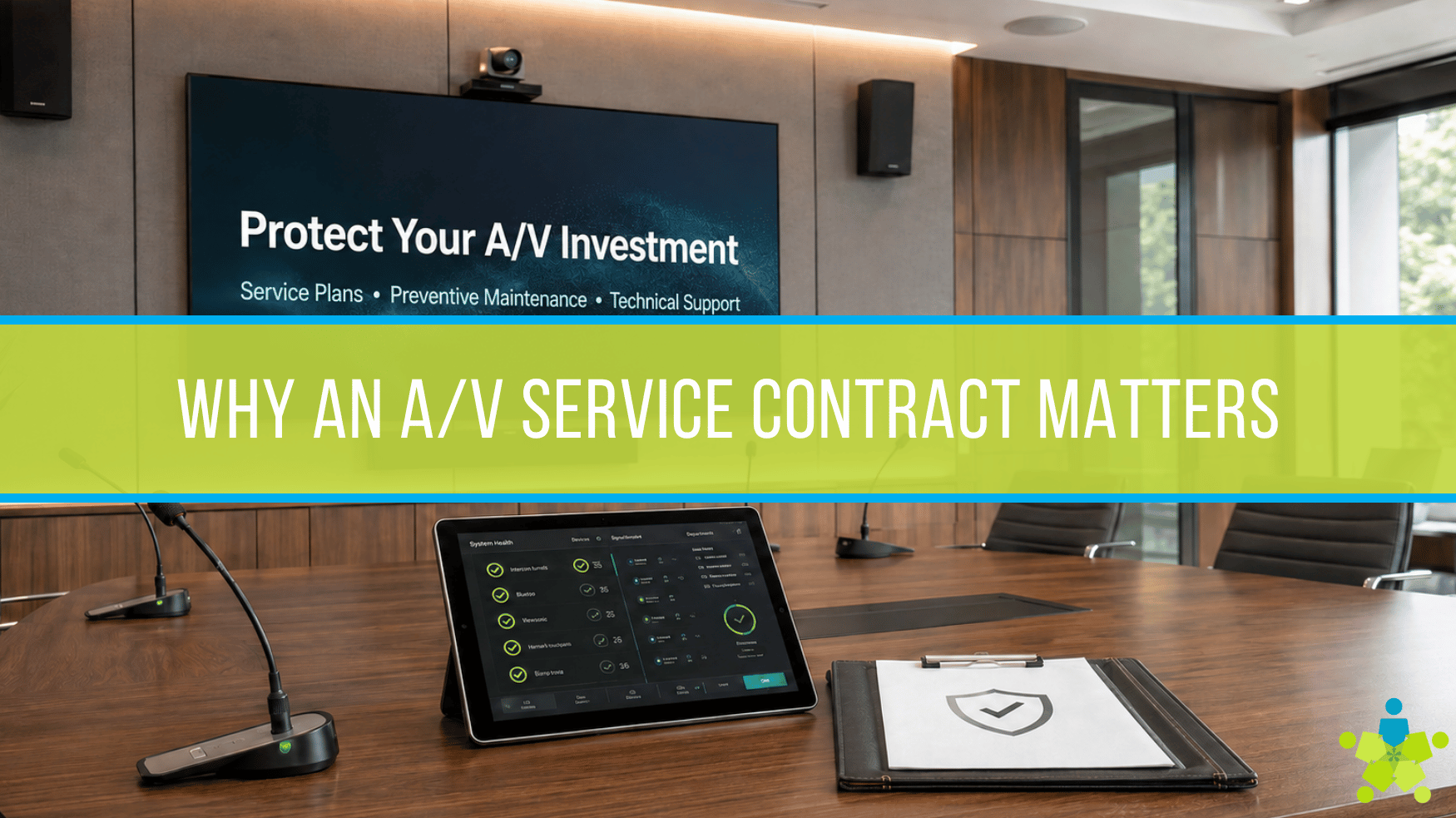
Your audiovisual system should not become another support burden. Whether you manage classrooms, boardrooms, council chambers, lecture halls, or public spaces, your AV environment has one job: help people communicate clearly when it matters.
That sounds simple. In practice, AV systems include many connected parts. Displays, microphones, speakers, cameras, control panels, digital signage, routing, streaming, recording, and networked devices all need to work together. When one piece fails, the room slows down. Meetings start late. Teachers lose instructional time. Public meetings become harder to follow. Hybrid participants miss key details.
A service contract helps prevent those issues from becoming daily frustrations.
For organizations searching for AV service contracts, audiovisual maintenance plans, AV support services, conference room AV maintenance, classroom AV support, or an AV system health check, the goal is usually the same: keep technology reliable, usable, and ready for the people who depend on it.
At DPI, that fits our core promise: reliable, easy-to-use AV systems that elevate communication, safety, and decision-making through rigorous design, verified performance, and long-term support.
AV Systems Need Ongoing Care
Most organizations would not install a network, security system, or HVAC system and then ignore it for years. AV deserves the same discipline.
Modern AV systems are more powerful than older, stand-alone equipment. A single room may include a display, touch panel, DSP, microphones, speakers, cameras, wireless presentation tools, control processor, video conferencing platform, and network connections. Larger environments may add DV-LED video walls, digital signage, AV-over-IP routing, lecture capture, public meeting streaming, assistive listening, or emergency messaging.
That flexibility creates value. It also creates more points that need to be checked, updated, cleaned, tested, and documented.
Without regular service, small issues can build quietly. A microphone battery stops holding charge. A display input gets renamed. Firmware falls behind. A camera preset drifts. A speaker zone drops out. A touch panel no longer matches how the room is actually used. None of these problems may seem urgent on their own. Together, they create unreliable rooms.
A service plan gives your team a structured way to catch problems early and keep systems aligned with real use.
What Is an AV Service Contract?
An AV service contract is an agreement that gives your organization ongoing support for installed audiovisual systems. The details vary by plan level, but service contracts often include scheduled maintenance, troubleshooting, remote or onsite support, system testing, documentation updates, priority response options, and recommendations for upgrades or repairs.
The purpose is not just to fix broken equipment. It is to protect room readiness.
For a school district, that may mean keeping campus-wide communication systems, classroom displays, PA systems, bells, digital signage, and emergency messaging tools working as expected. For a corporate office, it may mean making sure boardrooms, Teams Rooms, Zoom Rooms, AI cameras, microphones, and DV-LED displays are ready before leadership meetings. For higher education, it may mean supporting lecture capture systems, classroom standardization, campus signage, and accessibility needs. For government, it may mean protecting public meeting audio, streaming, recording, speaker queues, and assistive listening systems.
The right service contract helps each environment perform the way users expect.
Why Service Plans Reduce Downtime
Downtime rarely happens at a convenient time. A camera fails before a board presentation. A projector does not display before class. A microphone cuts out during a public comment period. A video wall shows the wrong source during a meeting.
When there is no service plan, teams often respond reactively. Someone submits a ticket. Internal IT investigates. The issue gets escalated. Parts are researched. A technician is scheduled. By then, the room may have already missed its purpose.
A service plan changes that pattern.
With scheduled maintenance and a clear support path, your organization can identify issues before users report them. Technicians can test signal flow, inspect equipment, check cabling, validate displays, review control behavior, confirm audio quality, and verify that rooms still match operational needs.
That matters because AV reliability affects more than equipment. It affects trust. When users believe a room will work, they use it with confidence. When they expect problems, they bring workarounds, avoid the space, or call support before every meeting.
What an AV Health Check Can Reveal
Not every organization is ready to choose a long-term service contract immediately. That is why an AV system health check is often the best first step.
A health check gives you a practical view of your current AV environment. DPI can come onsite, review your systems, document what is working, identify risks, and give you best recommendations based on your rooms, users, and priorities.
An AV health check may evaluate:
- Audio clarity and microphone performance
- Display condition, brightness, input behavior, and visibility
- Camera placement, framing, and hybrid meeting experience
- Control panel usability and button logic
- Signal routing and source reliability
- Cable condition and equipment rack organization
- Firmware, configuration, and network-connected device status
- Digital signage playback and emergency messaging paths
- Room readiness for Teams, Zoom, Google Meet, or other platforms
- User experience for teachers, executives, operators, or public meeting staff
The outcome should be clear and actionable. You should know what needs immediate attention, what can be monitored, and what may need to be planned into a future budget.
This approach also helps separate true priorities from nice-to-have upgrades. Sometimes the best recommendation is a repair. Sometimes it is training. Sometimes it is a control update. Sometimes it is phased modernization.
Different Levels of Service Plans Support Different Needs
Not every organization needs the same level of AV support. A single conference room does not require the same plan as a multi-campus district, a large university, or a public meeting facility with streaming and archival needs.
That is why service plans should scale.
A basic service level may focus on periodic inspections, standard troubleshooting, and recommendations. A more comprehensive plan may include more frequent preventive maintenance, priority scheduling, remote support, documentation updates, and deeper system testing. Advanced environments may need stronger response expectations, support for high-visibility rooms, lifecycle planning, and coordination across IT, facilities, communications, and administration.
The right plan depends on how critical the system is.
Ask these questions:
- How often is the room used?
- Who uses it?
- What happens if it fails?
- Is it tied to safety, instruction, public access, executive meetings, or revenue-generating events?
- Does internal IT have AV expertise?
- Are there multiple technology platforms involved?
- Are there aging components that need closer monitoring?
For high-use and high-impact rooms, a stronger service plan is often the better investment. For smaller systems, a lighter plan plus periodic health checks may be enough.
Service Contracts Help Internal Teams
A good AV maintenance plan does not replace your internal team. It supports them.
Many IT and facilities teams already carry full workloads. They manage networks, endpoints, cybersecurity, building systems, help desk tickets, procurement, and user training. AV can sit awkwardly between departments. It includes hardware, software, room design, user behavior, acoustics, and network dependencies.
When something goes wrong, internal teams may spend hours narrowing the issue before they know whether the problem is a cable, a display, a microphone, a conferencing platform, a DSP setting, or a control system.
A service contract gives your organization a specialized partner.
That support can reduce guesswork, speed troubleshooting, and provide documentation that helps teams make better decisions. It can also create a clearer path for budgeting. Instead of waiting for emergency failures, your team can see which systems are aging, which rooms need upgrades, and which improvements can be phased.
Service Protects the User Experience
The best AV systems feel simple to users. A teacher should not need to troubleshoot a display before starting class. An executive should not need to adjust audio settings before a hybrid meeting. A city clerk should not need to fight with microphones during public comment. A professor should not need to wonder whether lecture capture worked.
Ease of use is not accidental. It comes from thoughtful design and consistent support.
DPI’s approach focuses on clarity, reliability, speed-to-value, and lifecycle support. Those are not just design principles. They also apply after installation.
Service helps preserve the original intent of the system. It checks whether the room still works for the people using it today. If workflows have changed, the service process can surface that. If users need training, the service process can reveal it. If technology is underused, the service process can help explain why.
What to Look for in an AV Support Partner
When comparing AV support services or audiovisual maintenance plans, look beyond response time alone. Speed matters, but it is not the only factor.
A strong AV service partner should understand your full environment. They should be able to support displays, audio, video, control, signage, streaming, routing, and platform integrations. They should communicate clearly with IT and facilities teams. They should document findings. They should avoid vague recommendations and help you understand the tradeoffs.
Most importantly, they should design support around outcomes.
For K-12, that may mean teacher ease-of-use, safety responsiveness, and district-wide communication coverage. For corporate teams, it may mean decision velocity, hybrid meeting quality, and uptime. For higher education, it may mean classroom readiness, lecture capture reliability, accessibility alignment, and reduced support load. For government, it may mean public meeting transparency, reliability, recording, and ease of operation.
When Should You Schedule an AV Health Check?
You do not need to wait for a failure.
Schedule an AV health check if:
- Users complain that rooms are hard to use
- Meetings often start late because of technology issues
- Teachers or presenters avoid certain rooms
- Audio quality is inconsistent
- Displays, projectors, or video walls show signs of age
- Digital signage is unreliable or difficult to update
- Hybrid participants struggle to hear or see clearly
- Your organization has not reviewed AV systems in the last year
- You are planning budget for upgrades or replacements
- You want to compare service plan options before committing
A health check gives you a practical baseline. From there, DPI can recommend the service level that fits your systems, risk level, and budget.
Keep Your AV Systems Ready for Day One and Day 900
An AV system should not only work on the day it is installed. It should keep working as people, rooms, platforms, and expectations change.
That requires more than equipment. It requires ongoing support.
A service contract helps your organization protect reliability, reduce downtime, support internal teams, and improve the user experience. A health check gives you a clear starting point. Together, they help you move from reactive fixes to proactive planning.
Whether you manage one high-visibility boardroom or a large network of classrooms, meeting spaces, signage, and public rooms, DPI can help you understand the condition of your AV systems and choose the right level of service.
Ready to Know Where Your AV Systems Stand?
Schedule an AV health check with DPI. We will review your current environment, identify risks, and provide practical recommendations for service, maintenance, and long-term system performance.


Darlene Rankin
Darlene Rankin is the Education Business Development Manager at Data Projections, Inc. She is an accomplished education technology leader with over twenty years of experience, including twenty-four years as Director of Innovation and Instructional Technology at Katy ISD in the Greater Houston Area. In 2025, she joined DPI to focus on expanding AV technology solutions for Texas schools and supporting innovation, collaboration, and student success.